As someone who’s grown up and studied in the United States, Dr. Aaron Griffith has been exposed to American evangelical Christian viewpoints on a variety of political, cultural and economic issues. However, when it came time to write his dissertation, he noticed that there was crucial dialogue missing around matters of law and order.
“There wasn’t a lot written about the history of modern evangelical influence on criminal justice,” he says. “Throughout graduate school, I’d been reading these wonderful books about the history of prisons and criminal justice in the modern United States. While those scholars were doing great work, they weren’t talking about religion as much as I thought they should. My academic inspiration really began there, in wanting to put those two bodies of scholarship in conversation together.”
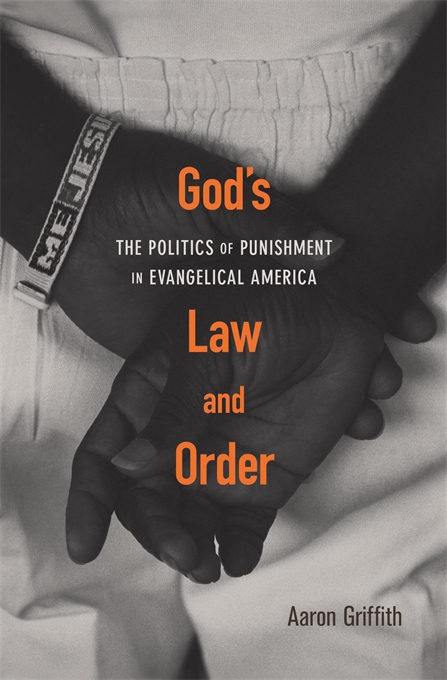
Griffith is the winner of the 2021 Emerging Public Intellectual Award. The award, hosted by Redeemer University and sponsored by the Acton Institute, Cardus, the Center for Public Justice, the Council for Christian Colleges and Universities (CCCU) and the Henry Institute at Calvin University, is intended to recognize and foster emerging talent and those working in the Christian academy who excel in both academic and public spheres and whose work impacts the common good. He has written articles for and been quoted in Christianity Today, The Washington Post, Deseret News, The Atlantic and other notable publications. His first book, God’s Law and Order: The Politics of Punishment in Evangelical America, was released by Harvard University Press in November 2020. With it, he hopes to address the overlap between evangelicalism and mass incarceration in the United States.
“I wanted to see what happens when we tell the story of modern evangelicalism with an eye towards concerns about prison, prison reform and language around crime and punishment,” he says.
It’s a story, he goes on to explain, that has been unfolding for quite some time.
“Since the mid-20th century, evangelicalism has become much more influential and popular. Around the same time, the American prison and criminal justice systems started to expand. I try to connect them, showing how evangelicals influenced anti-crime politics through their religious arguments and by framing anti-crime efforts as desirable. As mass incarceration took hold, evangelicals also became more involved in prison ministry and even began to address inequalities within the prison system.”
Griffith believes one of the biggest factors that made law enforcement a religious issue is the view that breaking the law is the same as committing a sin. Although this might make sense on a surface level, the equation isn’t always that simple.
“Crime, simply as a breaking of the law, can mean all kinds of different things. There are some laws that we as Christians think are just and need to be in place. But, there are a lot of laws that are not categorized as sins or that disproportionality impact certain kinds of communities. Evangelicals’ language of sin here meant that sometimes they would offer grace and forgiveness to those who broke the law. But it also gave punitive anti-crime efforts a sacred weight, one that more often than not fell on poor and Black communities.”
References to crime, punishment and incarceration are everywhere in Scripture, and I think this is evidence of God’s heart for these kinds of concerns, and that we have an opportunity to join him in that work.
His work also has a personal component.
“I spent some time in graduate school volunteering with a prison ministry and got to know fellow Christians who were incarcerated themselves or had experience in the criminal justice system. I started to wonder how I could help Christians think about these very complicated political and personal concerns.”
Griffith hopes that those who encounter his work will realize that the criminal justice system is still in great need of Christ-like love and justice.
“These systems can harm the most vulnerable, marginalized people in our society and have often been justified using religious logic. At the same time, there are powerful resources within Christianity to help us develop solidarity with those affected by them. Jesus says in Matthew 25 that he wants his followers to clothe the naked, feed the hungry and visit those in prison. References to crime, punishment and incarceration are everywhere in Scripture, and I think this is evidence of God’s heart for these kinds of concerns, and that we have an opportunity to join him in that work.”
Griffith’s book is on sale at Redeemer’s campus bookstore, 21Five, at the discounted rates of $5 for students and $10 for faculty and staff.